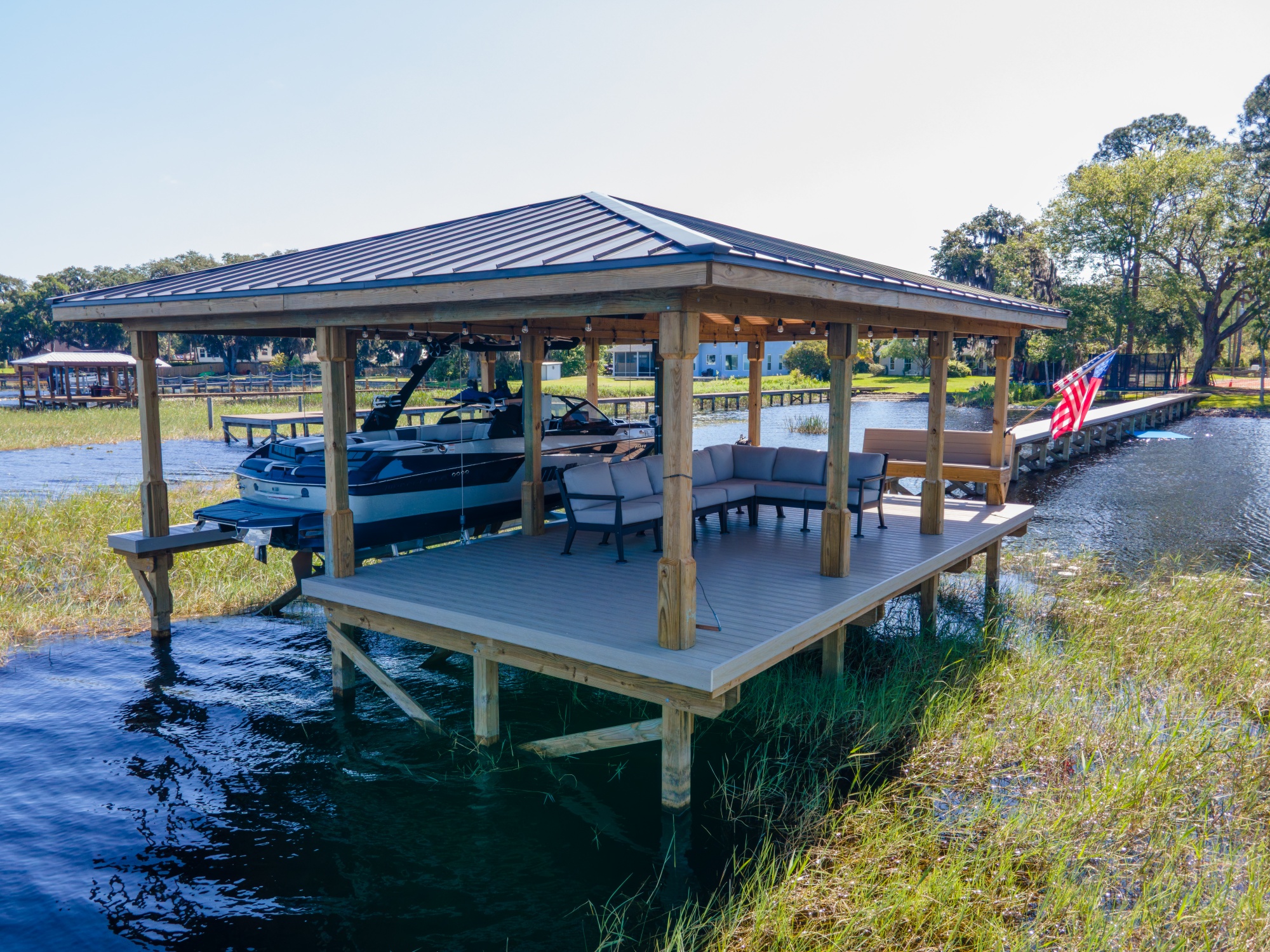
A small amount of movement does not automatically mean a dock is failing. Waterfront structures are exposed to changing loads, water movement, weather, and repeated everyday use. However, a dock that suddenly feels less stable, moves noticeably when people walk across it, or appears to be shifting deserves attention.
The important question isn’t simply, “Does my dock move?” It’s whether that movement is normal for the dock’s design or a sign that part of the structure has weakened.
At Hansen Marine Construction, we build and work with waterfront structures throughout Central Florida. Here are some of the areas worth examining when a fixed dock no longer feels as solid as it once did.
Start by Identifying Where the Movement Happens
Before assuming the entire dock has a structural problem, pay attention to where you notice movement.
Does it occur:
- Near the shoreline connection?
- In one particular section?
- At the outer end of the dock?
- Around a piling?
- Only when several people are on the dock?
- When a boat or waves create additional movement?
The location and circumstances can provide useful clues about which part of the structure needs closer examination.
Check the Pilings 🪵
Pilings are a critical part of many fixed dock structures because they transfer loads into the supporting ground below the water.
If a piling has deteriorated, shifted, or lost adequate support, the dock above it may begin to feel different.
Possible warning signs include:
- A piling that appears out of alignment
- Visible deterioration near the waterline
- Connections pulling away from a piling
- One portion of the dock moving more than surrounding sections
Because much of a piling is underwater or below the bottom, its condition cannot always be determined from what is visible above the surface.
Look at the Framing Beneath the Deck
Deck boards are what you walk on, but the framing underneath them provides much of the structural support.
When inspecting accessible areas, look for obvious changes such as:
- Cracked structural members
- Loose connections
- Significant deterioration
- Sections that appear out of alignment
- Areas that sag compared with the rest of the dock
Avoid climbing underneath or entering the water to investigate areas that cannot be reached safely.
Loose Hardware Can Create Noticeable Movement 🔩
A dock is made from multiple components connected together. When connections loosen or deteriorate, movement between those components can become more noticeable.
Corrosion is particularly relevant around waterfront structures because fasteners and connectors are repeatedly exposed to moisture.
A loose board is different from movement involving a structural connection. If several parts of the dock appear to move together, the issue deserves more careful evaluation than simply replacing a deck screw.
Pay Attention to the Shoreline Connection
The transition between land and dock can sometimes reveal problems that aren’t immediately obvious farther out over the water.
Look for:
- Soil disappearing around the approach
- New gaps between the dock and surrounding ground
- Settlement near the shoreline
- Changes around an adjacent seawall
- Uneven transitions onto the dock
A dock problem and a shoreline problem can sometimes appear together, so it is useful to look at the waterfront as a complete system.
Has the Movement Recently Become Worse? ⚠️
Changes over time matter.
A dock that has behaved the same way for years is different from one that suddenly begins swaying, bouncing, leaning, or shifting noticeably.
Consider whether anything has recently changed, such as:
- A significant storm
- Unusual water conditions
- Impact from a boat or floating debris
- Visible shoreline erosion
- Increasing deterioration of older components
Taking photographs of questionable areas can also make it easier to determine whether movement or deterioration is progressing.
When Should You Stop Using a Dock?
If the dock appears structurally unstable, has severely deteriorated components, significant leaning or settlement, missing structural connections, or movement that makes walking unsafe, limiting access until it can be evaluated is the sensible approach.
Don’t rely on appearance alone. A dock can have attractive decking while important structural components underneath are deteriorating.
Likewise, an older-looking dock isn’t necessarily unsafe simply because its surface is weathered.
The underlying structure matters most.
Can a Shaky Dock Be Repaired?
Sometimes.
Whether repair makes sense depends on what is causing the movement and how much of the structure is affected.
A localized problem involving a connection or limited section is very different from widespread deterioration involving pilings and structural framing. That’s why identifying the cause should come before deciding whether to repair individual components or consider more extensive dock work.
Hansen Marine Construction provides dock construction and waterfront construction services throughout Central Florida. If your dock has developed unusual movement or you’re considering replacing an aging structure, a proper evaluation can help determine the appropriate next step.
Frequently Asked Questions About Dock Movement
Is it normal for a fixed dock to move slightly?
Some movement may occur depending on the dock’s design and conditions. New, excessive, or increasing movement is more concerning and should be evaluated.
Why does my dock bounce when I walk on it?
Several factors can contribute, including framing, connections, span, or support conditions. The location of the movement can help identify where to investigate.
Can loose pilings make a dock wobble?
Problems involving piling support can contribute to instability because pilings are a major part of the foundation of many fixed docks.
Should I replace the decking if my dock feels unstable?
Not automatically. Decking is only the walking surface. If the movement comes from the framing, connections, or pilings, replacing deck boards alone won’t address the underlying issue.
Can shoreline erosion affect a dock?
It can affect the land surrounding the dock approach and other waterfront structures. Changes around the shoreline should therefore be considered when evaluating unusual dock movement.
Does a moving dock always need to be replaced?
No. The appropriate solution depends on the cause, condition, and extent of deterioration. Some problems may be repairable, while more widespread structural issues can make replacement the more practical option.